In short
- The main chest muscle is the pectoralis major, helped by the front of the shoulders and the triceps.
- The bench press and the push-up are the two foundation chest exercises, one for the gym and one for home.
- On the bench press, keep your shoulder blades back and down and your elbows roughly 45–70 degrees from your body.
- Beginners do 2–3 sets of 8–12 reps twice a week; intermediates 3–4 sets of 6–12.
The best chest exercises are the bench press, push-up, incline dumbbell press, dips and flyes. At the gym, the bench and incline press form the base of your chest workouts; at home, push-up variations can keep you progressing for months.
Below is step-by-step technique for the key lifts, the mistakes behind most shoulder niggles, and two programmes: one for the gym and one for home.
The chest muscles
- Pectoralis major: the big chest muscle, with an upper (clavicular) and main (sternal) portion.
- Pectoralis minor: underneath, helping to move the shoulder blade.
- Helpers: the front deltoid and the triceps.
Incline pressing emphasises the upper chest; flat pressing and dips hit the main and lower portion.
Bench press, step by step
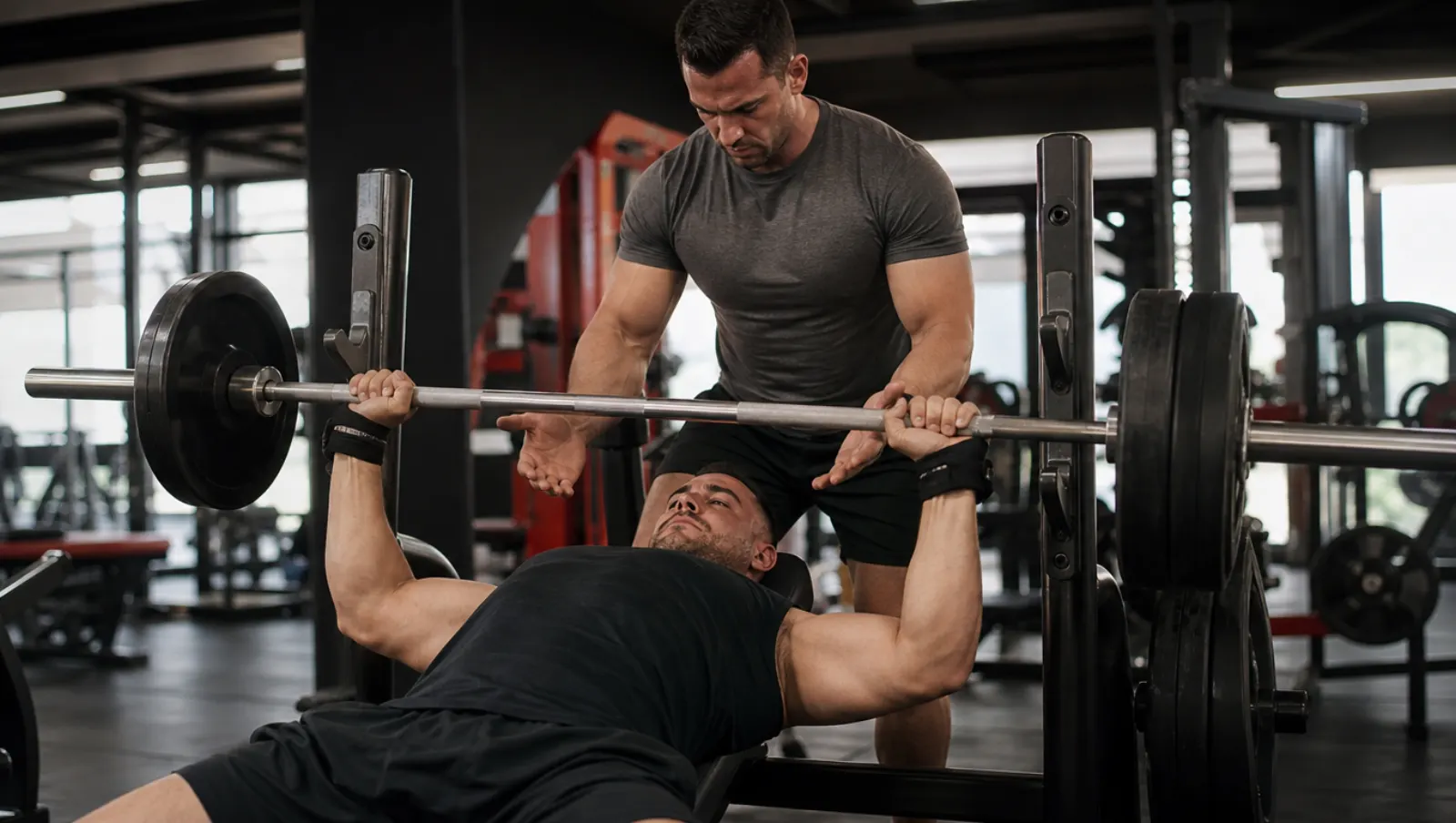
- Lie on the bench with your eyes just below the bar and your feet planted.
- Grip the bar slightly wider than shoulder-width, wrists stacked over elbows.
- Set your shoulders: pull your shoulder blades back and down, as if tucking them into your back pockets. A slight natural arch is fine; your glutes stay on the bench.
- Unrack with straight arms and bring the bar over your shoulders.
- Lower under control to your lower chest, around nipple line, elbows about 45–70 degrees from your torso, not flared to 90.
- Press up and slightly back towards your shoulders, driving your feet into the floor and breathing out.
When you go heavy, always use a spotter or safety arms.
Push-up, step by step
- Hands slightly wider than shoulders, fingers forward.
- Body in a straight line from head to heels, glutes and abs tight.
- Lower until your chest is a few centimetres from the floor, elbows about 45 degrees from your body.
- Push the floor away to rise.
Can't do eight clean push-ups yet? Put your hands on a bench or table. The higher the surface, the easier the rep.
Other chest exercises
- Incline dumbbell press: bench at 30–45 degrees. Lower the dumbbells beside your upper chest and press them up and slightly together. Targets the upper chest.
- Dips: support yourself on parallel bars, lean slightly forward and lower until your shoulders are just below your elbows, then press up. If your shoulders complain, shorten the range or use an assisted machine.
- Cable or dumbbell fly: elbows slightly bent and locked, open your arms wide, then bring them together as if hugging a tree. Go light; this isn't a strength test.
- Machine chest press: a good beginner option because the machine guides the path. Set the seat so the handles line up with your chest.
- Feet-elevated push-up: a home progression that works the upper chest harder.
Warming up
Shoulders are the joint most likely to complain on chest day, so a 5–10 minute warm-up is worth it:
- A few minutes of easy cardio, such as brisk walking or cycling, to raise your body temperature.
- Arm circles and band pull-aparts for the back of the shoulders.
- 10–15 easy push-ups, or incline push-ups.
- Before your first heavy set, do 2–3 ramp-up sets with the empty bar and rising weights, fewer reps each time.
It also lets you rehearse your technique before the load gets heavy.
Common mistakes
- Elbows flared to 90 degrees, which loads the shoulders. Tuck them in.
- Shoulders rolling off the bench. You lose stability and strength. Keep them pinned.
- Bouncing the bar off your chest.
- Hips lifting off the bench. Drive with your legs, keep your glutes down.
- Half reps. A shorter range builds less strength.
- All chest, no back. For healthy shoulders, do at least as many sets for your back as for your chest.
Gym and home programmes
The American College of Sports Medicine (ACSM) suggests novices begin with 1–3 sets of 8–12 reps. The World Health Organization (WHO) recommends muscle-strengthening activity for all major muscle groups on at least two days a week.
Gym
| Level | Exercises | Sets × reps | Rest |
|---|---|---|---|
| Beginner | Machine chest press, push-up, cable fly | 2–3 × 10–12 | 60–90 s |
| Intermediate | Bench press, incline dumbbell press, dips, fly | 3–4 × 6–12 | 90–180 s on bench |
Home
| Level | Exercises | Sets × reps | Rest |
|---|---|---|---|
| Beginner | Incline push-up (hands on bench), knee push-up | 2–3 × 8–12 | 60 s |
| Intermediate | Push-up, feet-elevated push-up, slow push-up (3 s down) | 3–4 × 8–15 | 60–90 s |
How to progress
Keep progress small and steady. A simple method: once you hit the top of the range on every set, say 3 sets of 12, add the smallest weight jump available and drop back to 8 reps. At home, move to a harder push-up variation once 15 reps feel easy. Log your weights and reps on your phone so you know what to beat next time.
Pick a load where the last two or three reps are hard but clean. Add weight or reps only when every set looks good. To plan by percentages, estimate your bench max with our one-rep max calculator.
Muscle growth also needs enough protein; see our list of high-protein foods.
Safety
If you have a shoulder, elbow or wrist injury, a medical condition, or you are pregnant, talk to a doctor or physiotherapist before starting.
Where to train
Bench pressing and dips need a gym with a bench and barbell. JetoFit partner gyms include SevenGym and KoSport in Pristina, Gorilla Gym in Fushë Kosovë and Power Gym in Vushtrri, all covered by a JetoFit membership. Equipment varies from gym to gym, so check in the app or ask the staff. New to lifting? Start with our first gym programme and the complete exercise guide.
Frequently asked questions
How often should I train chest?
Twice a week suits most people, with at least one rest day between hard sessions.
Are push-ups enough to build a strong chest?
For beginners, yes, for a few months. Once you can easily do more than 20 reps, move to harder variations or add weights.
Why does my shoulder hurt when I bench?
Often because your elbows flare too wide or your shoulder blades aren't set. If the pain persists, stop and see a physiotherapist.
Barbell or dumbbells for chest?
Both work. A barbell lets you lift more; dumbbells allow a freer path and train each side separately. Many programmes use both.