In short
- A kettlebell is a cast-iron ball with a handle, and one bell is enough for a complete strength and conditioning workout.
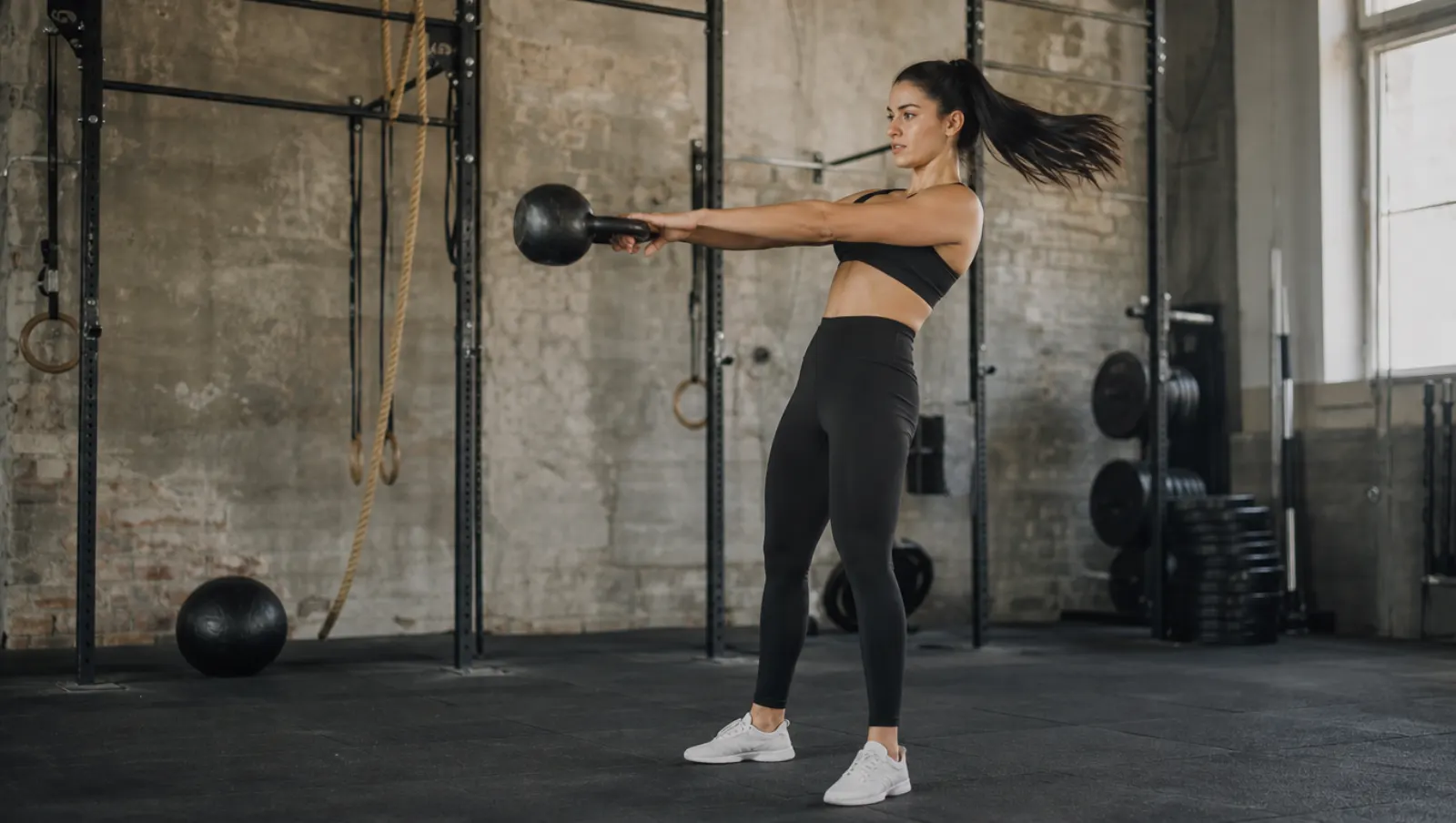
- The kettlebell swing is a hip hinge, not a squat and not a front raise.
- Learn the deadlift and goblet squat before you learn the swing.
- Choose a bell you can move cleanly for 10–12 reps; form comes before load.
- Four to six kettlebell exercises can train your whole body in 20–30 minutes.
Kettlebell exercises train your whole body with a single piece of kit: legs, glutes, back, shoulders and core. The ten moves below are enough to build real strength and conditioning, provided you learn them in order, starting with the deadlift and goblet squat before the swing.
Because a kettlebell's centre of mass sits outside your hand, your body has to work harder to control it than with a dumbbell. That is what makes it so good for dynamic lifts like swings and cleans.
Choosing your weight
Choose by movement quality, not by the number on the bell. For slower lifts (squat, press, row), pick a weight you can move cleanly for 10–12 reps. Hinges like the deadlift and swing usually take a heavier bell than presses, because your hips and legs do the work. If your form breaks before the last rep, the bell is too heavy.
10 kettlebell exercises
1. Kettlebell deadlift
The foundation for everything else.
- Stand with feet hip-width apart, bell between your feet.
- Push your hips back, bend your knees slightly and grip the handle with both hands, back flat.
- Brace and stand up by pushing the floor away and driving your hips forward.
- Squeeze your glutes at the top without leaning back. Lower the same way.
2. Goblet squat
- Hold the bell by the horns at chest height, elbows pointing down.
- Feet slightly wider than shoulders, toes turned out a little.
- Sit down between your knees, chest up, heels down.
- Go as deep as you can with a neutral back, then stand through your whole foot.
3. Two-handed swing
The signature kettlebell move, and the one most often done wrong.
- Set the bell about 30 cm in front of you. Hinge and grip it with both hands.
- Hike it back between your thighs.
- Snap your hips forward and squeeze your glutes. The bell floats to roughly chest height on hip power alone.
- Your arms are ropes. They guide the bell; they don't lift it.
- Let it fall, wait until your forearms meet your thighs, then hinge into the next rep.
4. One-arm row
- Brace your free hand on a bench or your knee, back roughly parallel to the floor.
- Pull the bell towards your hip, elbow close to your side.
- Squeeze your shoulder blade at the top and lower slowly.
5. Halo
- Hold the bell upside down by the horns in front of your face.
- Circle it slowly around your head, close to your neck, ribs down and core tight.
- Do equal circles in both directions. Go light.
6. Single-arm overhead press
- Bring the bell to the rack: at the shoulder, handle deep in the palm, bell resting on the outside of the forearm.
- Squeeze your glutes and brace.
- Press until your arm is straight, biceps by your ear. Lower under control.
7. Reverse lunge
- Hold the bell in a goblet or rack position.
- Step back and lower until your back knee hovers above the floor.
- Drive through your front heel to return. Alternate legs.
8. Suitcase carry
- Hold one bell at your side.
- Walk 20–30 metres tall and level, without leaning towards the weight.
- Switch hands. Great for the core and grip.
9. Single-arm clean
- Start as for a one-arm swing.
- Instead of letting the bell float out, keep it close and pull your elbow back.
- Rotate your hand around the handle so the bell lands softly in the rack without banging your forearm.
10. Turkish get-up
An advanced move. Learn it with no weight first, or with a shoe balanced on your fist.
- Lie down holding the bell straight up over your chest, same-side knee bent.
- Roll onto your elbow, then onto your hand.
- Lift your hips, sweep the straight leg under you into a kneel, and stand up.
- Reverse step by step to the floor, eyes on the bell throughout.
Common mistakes
- Squatting the swing: too much knee bend, not enough hip hinge. Think "hips back", not "sit down".
- Lifting with the arms: if your shoulders burn on swings, your arms are doing your hips' job.
- Rounded back: keep a neutral spine on deadlifts and swings.
- Leaning back at the top: finish tall like a plank.
- Going heavy too soon, especially on presses and get-ups.
Plans for beginners and intermediates
The American College of Sports Medicine (ACSM) suggests novices start with 1–3 sets of 8–12 reps for resistance exercises. These plans follow that logic.
| Beginner | Intermediate | |
|---|---|---|
| Exercises | Deadlift, goblet squat, row, suitcase carry | Swing, clean, press, reverse lunge, get-up |
| Sets | 2–3 | 3–5 |
| Reps | 8–12 (carry 20–30 m) | 6–10; swings 15–20; get-ups 1–3 per side |
| Rest | 60–90 s | 45–90 s or as a circuit |
| Frequency | Twice a week | 2–3 times a week |
Once a beginner completes every set with clean form for two sessions in a row, add the two-handed swing. Intermediates can run the moves as a circuit for more conditioning. To see how much energy you burn in a day, try our calorie calculator.
Safety
If you have back, shoulder or heart problems, a recent injury, or you are pregnant, talk to a doctor or physiotherapist before starting. A coach watching your first swings can save you weeks of bad habits.
Where to train with kettlebells
Kettlebells are a staple of CrossFit and most modern gyms. CrossFit and Hyrox training commonly use swings and carries. In Pristina, CrossFit Prishtina is JetoFit's CrossFit partner, and gyms such as KoSport are an option for training on your own. Check the app for class and equipment details. A JetoFit membership lets you try different gyms and classes on one subscription. For more, read about CrossFit in Kosovo, our Hyrox guide and our glute exercises.
Frequently asked questions
What kettlebell weight should I start with?
One you can move cleanly for 10–12 reps on goblet squats and deadlifts. You will usually need a lighter bell for presses.
Can I do kettlebell swings every day?
Beginners do better with two or three sessions a week and rest days in between. Once your technique is solid, short sets more often can work if your back and hips feel fine.
Do kettlebell workouts burn fat?
They burn energy and build muscle, but fat loss depends on your overall calorie balance and diet.
Are kettlebells safe for your back?
Yes, with a neutral spine and a sensible load. If you already have back pain, see a doctor or physiotherapist first.