In short
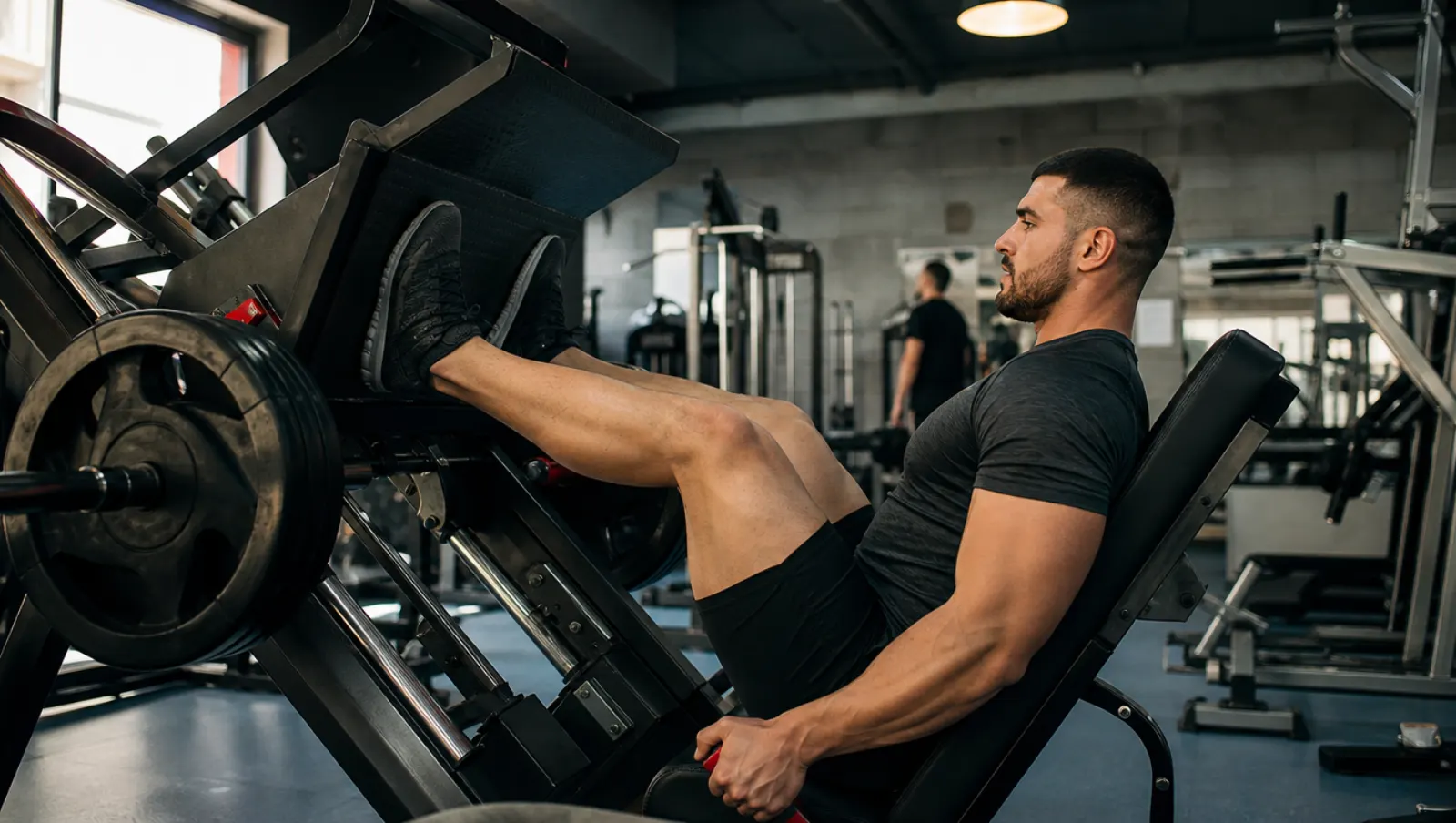
- The leg press mainly trains the quadriceps and glutes, with help from the adductors and hamstrings.
- Lower the platform only as far as your lower back and hips stay flat on the pad, usually around 90 degrees at the knee.
- Never fully lock your knees at the top and never let your hips roll up off the seat.
- Beginners do 2–3 sets of 10–15 controlled reps; intermediates 3–4 sets of 6–12.
The leg press is one of the safest ways to build leg strength, because the machine guides the movement and your back stays supported. Good leg press technique comes down to three things: feet in the middle of the platform, hips glued to the seat, and knees that never lock out at the top.
This guide covers setup, the movement step by step, the mistakes that cause most problems, and a simple sets-and-reps plan for beginners and intermediate lifters.
What the leg press works
Most gyms have one of two versions:
- 45-degree leg press: you lie back at an angle and push a sled loaded with plates up a rail.
- Horizontal (seated) leg press: you sit upright and push a platform forward, usually with a selectorised weight stack.
| Muscle | Role |
|---|---|
| Quadriceps (front of thigh) | Main driver, straightens the knee |
| Glutes | Extend the hip, especially at the bottom of the rep |
| Adductors (inner thigh) | Assist, more so with a wide stance |
| Hamstrings | Assist and stabilise |
| Calves | Light stabilising work |
If your main goal is your glutes, our glute exercise guide shows where the leg press fits alongside hip thrusts and lunges.
Leg press technique, step by step
1. Set the seat. Sit with your whole back against the pad. If the backrest angle adjusts, start in the middle. Find the safety handles before you load any weight.
2. Place your feet. Put your feet in the middle of the platform, about shoulder-width apart, toes turned out slightly. Your whole foot, heel included, stays in contact.
3. Unrack. Press the platform up just enough to release the safety catches. Keep a soft bend in your knees and hold the side handles.
4. Lower under control. Breathe in and lower the platform over two to three seconds. Your knees track in line with your toes. Stop around 90 degrees at the knee, or earlier if your hips start to lift off the seat. Everyone's depth is a little different.
5. Drive through your whole foot. Push back up through your heels and midfoot, breathing out as you go. Stop just short of straight legs.
6. Rack safely. After the last rep, press the platform to the top and lock both safety catches before taking your feet off.
Foot position and variations
Small changes in foot placement shift the emphasis:
- Feet high: more glutes and hamstrings.
- Feet low: more quads, but more stress on the knees. Use it sparingly.
- Wide stance: more adductors and glutes.
- Narrow stance: more outer quads.
- Single-leg press: useful if one leg is weaker. Start with half the load or less.
As a beginner, the standard mid-platform stance is all you need for the first few months.
Common leg press mistakes
- Locking the knees. Straightening fully under a heavy load moves the weight from muscle to joint. Keep a slight bend.
- Hips rolling off the seat. Going too deep tucks your pelvis and peels your lower back off the pad, which loads the spine. Cut the range where your hips stay down.
- Too much weight, too little range. The machine makes it easy to stack plates and move a few centimetres. Less weight through a full range builds more muscle.
- Knees caving in. Keep them in line with your toes. If they collapse, lighten the load.
- Heels lifting. Move your feet a little higher on the platform.
- Hands on knees. Keep your hands on the handles.
- Bouncing. Don't let the sled drop and rebound at the bottom. The controlled lowering is part of the exercise.
Sets and reps for beginners and intermediates
The American College of Sports Medicine (ACSM) suggests novices start with 1–3 sets of 8–12 reps for resistance exercises. Applied to the leg press:
| Level | Sets | Reps | Rest | Choosing the load |
|---|---|---|---|---|
| Beginner | 2–3 | 10–15 | 60–90 s | A weight you can move cleanly for 15 reps with 2–3 left in the tank |
| Intermediate | 3–4 | 6–12 | 90–120 s | Last reps are hard, but form stays clean |
Add weight only when you hit the top of the rep range on every set with good form. If you plan by percentages, estimate your max with our one-rep max calculator rather than testing a true max on the machine alone.
The World Health Organization (WHO) recommends muscle-strengthening activity for all major muscle groups on at least two days a week. A leg press session is an easy way to cover your legs on one of those days.
Leg press or squat?
The leg press doesn't replace the squat, but it isn't a lesser exercise either. Squats demand more balance and core work. The leg press lets you load your legs heavily without loading your spine as much and without a long learning curve. Many programmes use both: squats early in the session, leg press afterwards.
Building a routine from scratch? Start with our first gym programme and the complete guide to exercises by muscle group.
Safety
If you have knee, hip or back pain, a recent operation, a medical condition, or you are pregnant, check with a doctor or physiotherapist before starting. Stop if you feel sharp pain rather than muscle fatigue.
Where to train
Most fully equipped gyms have a leg press. A JetoFit membership gets you into partner gyms across several cities, including SevenGym and KoSport in Pristina. Equipment varies from gym to gym, so check the details in the app or ask the staff when you arrive.
Frequently asked questions
How deep should I go on the leg press?
Lower the platform as far as you can while your hips and lower back stay flat on the pad. For most people that is around 90 degrees at the knee.
Is the leg press good for glutes?
Yes, especially with your feet placed higher on the platform and a full range of motion. Pair it with hip thrusts for the best glute results.
Should I lock my knees at the top?
No. Keep a slight bend so the load stays on your muscles rather than the knee joint.
How much weight should a beginner use?
Pick a load you can move cleanly for 15 reps with two or three reps to spare, then add weight gradually as the sets get easier.