In short
- Calisthenics is strength training using your own bodyweight: push-ups, squats, rows, pull-ups and planks.
- The WHO recommends muscle-strengthening activity on at least 2 days a week, and calisthenics meets that with no equipment.
- Beginners progress fastest with 3 full-body sessions a week and gradually harder variations of each move.
- Move up a level only when every set hits the top of the rep range with clean technique.
Calisthenics is strength training with your own bodyweight instead of barbells and machines. A beginner calisthenics workout needs little or no equipment, and three 30–45 minute sessions a week are enough to get noticeably stronger within a month or two.
It suits people who want to train at home, travel a lot, or simply want to learn to move their body well before loading it with weights.
Why calisthenics works
The World Health Organization recommends that adults get 150–300 minutes of moderate aerobic activity per week, plus muscle-strengthening activity involving all major muscle groups on two or more days a week. Bodyweight training covers that second part on its own.
What makes it effective is the same principle behind any strength programme: progressive overload. You make the exercise slightly harder over time. With weights you add kilos. With calisthenics you change leverage, slow the tempo, add reps or move to a harder variation.
The five moves to master
Pick the level where you can do 8–12 good reps. Ego is the enemy here.
| Movement | Level 1 | Level 2 | Level 3 |
|---|---|---|---|
| Push-up | Wall push-up | Hands on a bench | Floor push-up |
| Squat | Sit-to-stand from a chair | Full bodyweight squat | Rear-foot elevated split squat |
| Row / pull | Row under a sturdy table | Row on a low bar | Pull-up negatives |
| Glute bridge | Two legs | 3-second pause at the top | Single leg |
| Plank | Knees down | Full plank | Side plank |
Push-ups. Hands slightly wider than shoulders, body in one straight line, elbows angled back at roughly 45 degrees. If your hips sag, go back to the bench version.
Squats. Feet about shoulder width, knees tracking over your toes, heels down. Go as deep as you can while keeping your back neutral.
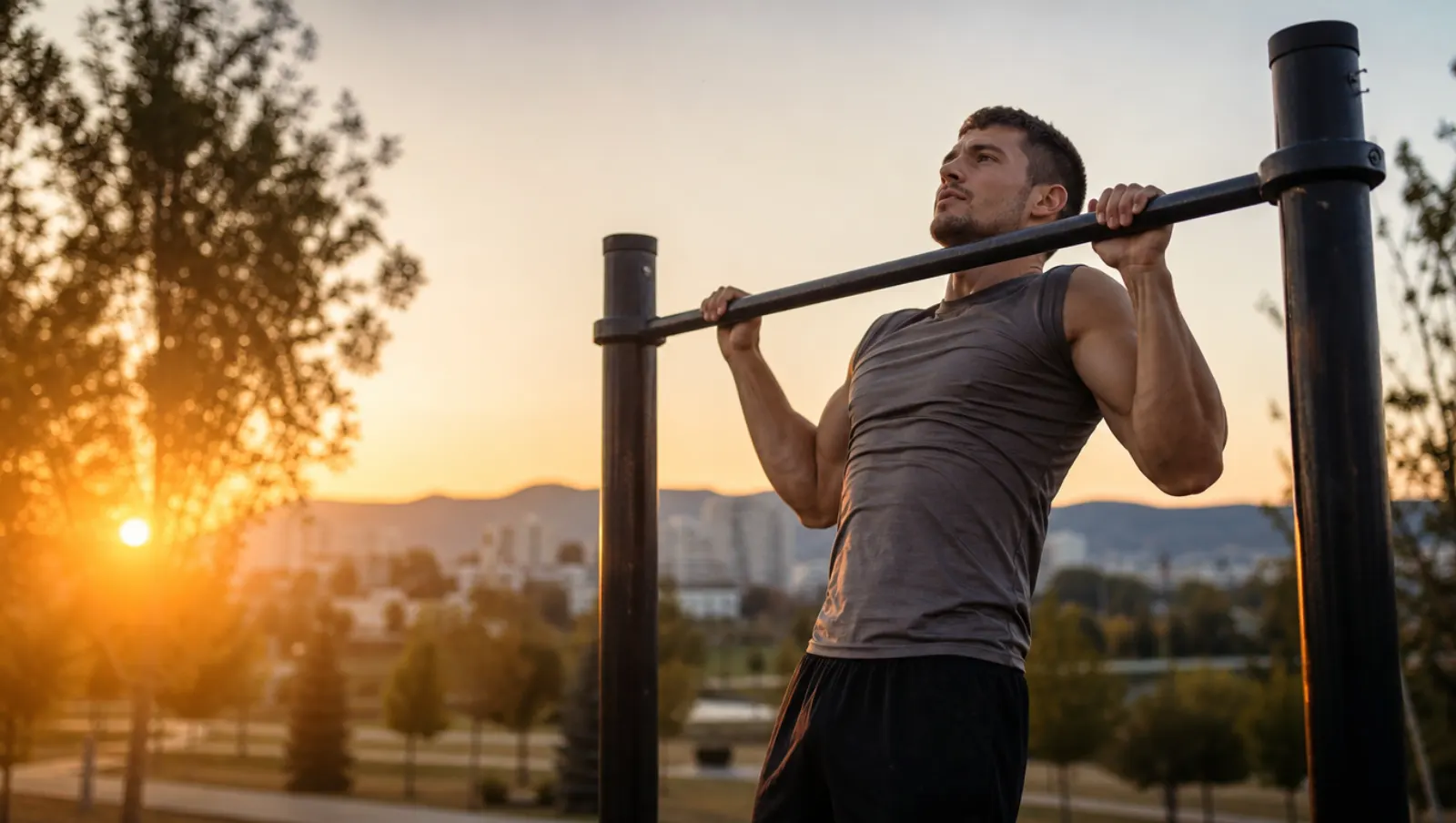
Rows and pull-ups. Most beginners overdo pushing and skip pulling, which leaves the shoulders unbalanced. Start with rows under a solid table or on a low bar. For your first pull-up, practise dead hangs of 10–30 seconds and negatives: jump to the top, then lower yourself slowly over 3–5 seconds.
Glute bridges and planks. Bridges wake up the glutes and hamstrings that long hours of sitting switch off. Planks teach your trunk to stay rigid. For more trunk work, see our guide to ab exercises.
A 4-week beginner plan
Train three non-consecutive days a week, for example Monday, Wednesday and Friday. Warm up for five minutes first: marching on the spot, arm circles, hip swings and a few easy squats.
- Weeks 1–2: 2 sets of each exercise
- Weeks 3–4: 3 sets of each exercise
- Squat: 8–12 reps
- Push-up: 6–10 reps
- Row: 6–10 reps
- Glute bridge: 10–15 reps
- Plank: 20–30 seconds
Rest 60–90 seconds between sets. Once you hit the top of the range on every set with clean form, move to the next level and start again at the bottom of the range. Keep one to three reps in reserve on most sets. Training to failure every time is not necessary for beginners and makes form break down.
Common mistakes
- Speed over control. Lower each rep over 2–3 seconds.
- Progressing too early. A floor push-up with sagging hips is not an upgrade.
- No pulling. Pair every set of push-ups with a set of rows.
- Skipping the warm-up. Wrists and shoulders need a few minutes.
- Ignoring recovery. Muscle is built between sessions, so sleep and protein matter.
How to track your progress
Keep a simple log on your phone: the date, the level of each exercise, and the reps you managed in every set. Progress in calisthenics is rarely linear. Some weeks you add two reps, some weeks nothing moves, and then you suddenly jump a level. A log stops you from guessing and shows you when it is time to move on.
After the first four weeks, repeat the plan with harder variations, or split it into upper-body and lower-body days if you want to train four times a week.
Home, park or gym
The plan above works in a living room. A park adds bars and benches for rows and pull-ups. A gym adds space, more equipment and coaches who can check your technique.
If you are in Pristina and want to mix bodyweight work with weights or classes, partner gyms such as KoSport and Big Jungle Gym are good options, and Pro Form Ks offers fitness sessions. Ask on site whether they have a pull-up bar or an assisted pull-up machine. A JetoFit membership lets you try several venues on one subscription before settling on a favourite.
When you are ready to add weights, our first gym programme is an 8-week plan built on the same movement patterns.
Food and recovery
Regular training goes further with enough protein spread across the day. Work out your target with the daily protein calculator, and aim for 7–9 hours of sleep.
If you have a heart condition, chronic pain, a recent injury, or you are pregnant, check with your doctor or a physiotherapist before starting a new programme.
Frequently asked questions
Can you build muscle with calisthenics alone?
Yes, especially as a beginner. Muscle grows when the work gets progressively harder, and calisthenics does that through harder variations, more reps and slower tempo.
How often should a beginner do calisthenics?
Three full-body sessions a week with a rest day between them is plenty for the first few months.
What if I can't do a single pull-up?
Build up with table or low-bar rows, dead hangs and slow negatives. Most people get their first pull-up after several weeks of consistent work.
Do I need equipment for calisthenics?
Not to start. A floor, a wall and a sturdy bench or table cover the basics; a pull-up bar opens up more options later.